


.png?v=1647475200)



















.jpg?v=1697597433)





What Is GEO? A Practical Guide to GEO vs SEO in the AI Search Era (Differences & Optimization Tactics)


In the past, when people talked about search marketing, most would first think of SEO—how to rank your website at the top of Google search results. But as generative AI search tools such as ChatGPT, Gemini, and Perplexity rapidly gain popularity, search behavior is undergoing a fundamental shift.
Users are no longer just “looking for links”—they want answers right away. This is why a new term is drawing attention: GEO.
So what is GEO? How is it different from SEO? And the question many people worry about most: will SEO be replaced by AI? In this article, Codepulse will answer all of these, and show you how to actually implement GEO optimization in practice.
What Is GEO? Why the AI Search Era Needs GEO
What Is GEO?
GEO stands for Generative Engine Optimization. It refers to a content optimization approach designed specifically for generative AI search engines.
In one sentence:
GEO isn’t about ranking #1—it’s about becoming a trusted source for AI-generated answers.
When users ask questions in tools like ChatGPT or Gemini, the AI reads, understands, and synthesizes information from vast amounts of content to generate an answer. GEO-optimized content is more likely to be selected and cited by AI.
The Biggest Difference Between AI Search and Traditional Search
Traditional Search (SEO):
- Users type in keywords
- The search engine shows a page of links
- Users click, compare, and read
Generative AI Search (GEO):
- Users ask questions directly
- AI aggregates information from multiple sources
- AI provides a conclusion-style answer (and may cite your content)
That’s why “whether the content clearly answers the question” matters far more than how many times a keyword appears.
How Is GEO Different from SEO? (A Complete GEO vs SEO Breakdown)
Many people see GEO and assume it’s a “new technology that replaces SEO.” In reality, they play different roles.
GEO vs SEO Comparison Table
| Category | SEO | GEO |
| Optimization Target | Search engines (Google) | Generative AI |
| Core Goal | Rankings, clicks, traffic | AI citations, becoming the answer |
| Key Factors | Keywords, links, technical SEO | Clear semantics, strong structure |
| Where Results Appear | Search results pages | AI-generated answers |
Key Takeaways
- SEO solves: “Can people find you?”
- GEO solves: “Will AI use you?”
If you don’t do SEO well, AI may not even discover your content.
But if you only do SEO and your content doesn’t answer questions clearly, AI may still choose not to cite you.
Traditional SEO Search Results Page

Image from a real Codepulse case study
- Article: 《Need Cash Urgently? 10 Recommended Options for Small Loans of 50,000 (NTD) — All in One Guide!》
- Keywords: urgent cash needs, small loan 50,000
Generative AI Search Page

Image from a real Codepulse case study
- Article: 《Are Facial Recognition Smart Locks Safe? Features, Benefits, and 5 Key Buying Tips—All in One》
- Keyword: facial recognition smart lock
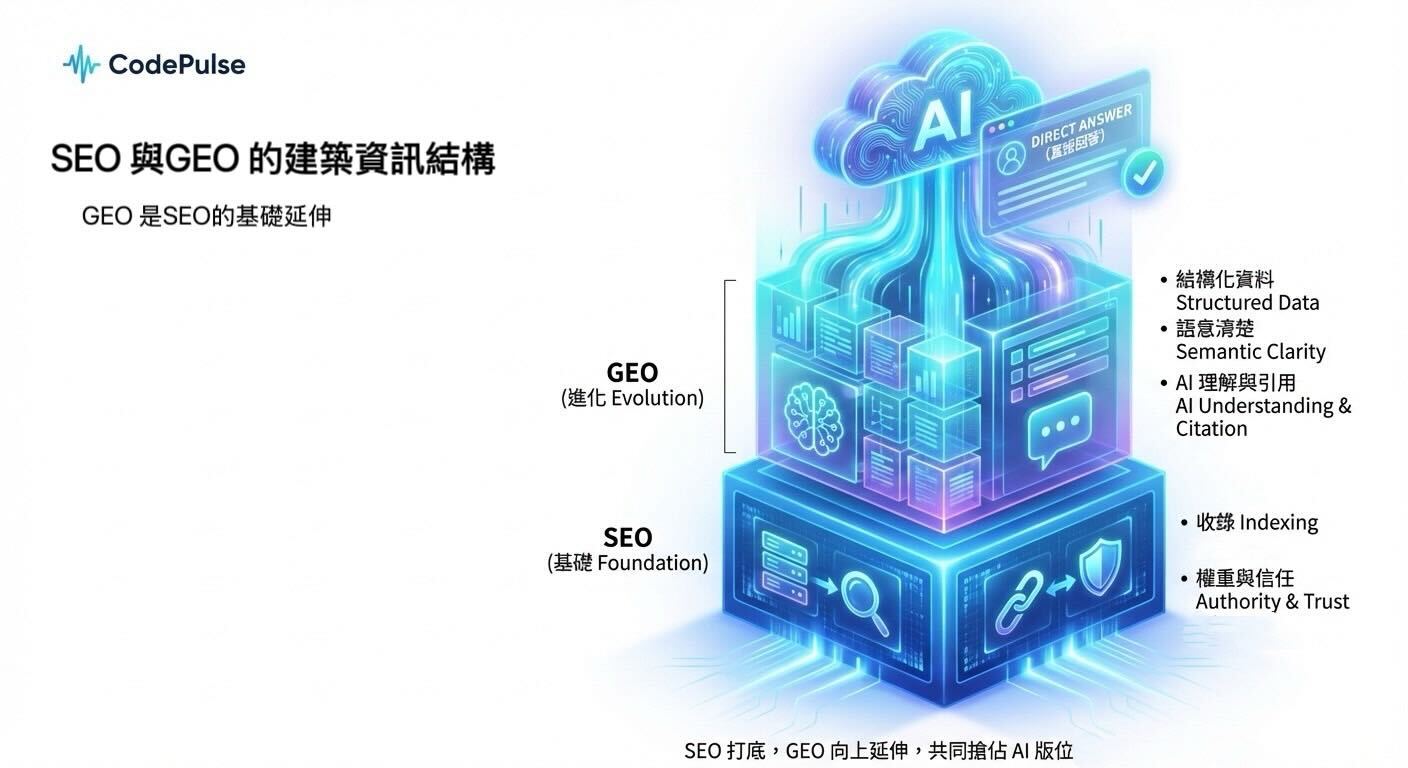
How Should GEO and SEO Work Together? Not Replacement—Evolution
A crucial concept:
GEO isn’t the enemy of SEO—it’s an extension built on top of an SEO foundation.
The right division of roles looks like this:
SEO:
- Helps content get indexed by search engines
- Builds domain authority and trust
GEO:
- Makes content semantically clear and well-structured
- Increases the likelihood that AI can understand and cite it
In other words:
Without SEO, GEO is hard to scale; but with only SEO, visibility in the AI era will become increasingly limited.
Will SEO Be Replaced by AI? The Most Common—and Most Misunderstood—Question
One of the most common questions in recent years is: will SEO be replaced by AI?
Why do people feel anxious about this?
Because user behavior is changing:
- More people are asking AI directly
- They may not click through to websites
- Content may be “seen but not clicked”
But the truth is:
SEO won’t be replaced by AI—in fact, it becomes even more important.
The reason is simple:
- AI answers rely on web content as source material
- High-quality SEO content is more likely to become AI reference material
- Without SEO, AI has “no materials to use”
What will be eliminated isn’t SEO, but:
- Shallow content
- Articles written only for keyword stuffing
- Information with no real value
📖 Related reading: 《What Should You Prepare for AISEO Trends in 2025? 3 Key Takeaways》
How to Do GEO Optimization? 5 Practical Content Principles
Now for the real core: how do you actually implement GEO optimization?
1. Answer the question directly—don’t circle around
One of AI’s favorite content traits is clarity.
❌ Bad example:
- The concept of GEO can actually be discussed from many angles…
✅ Good example:
- GEO is a way to optimize content so generative AI search engines are more likely to cite and use it.
2. Use Q&A-style headings and sections
- What is GEO?
- How is GEO different from SEO?
- Will SEO be replaced by AI?
This format is friendly for both human readers and AI.
3. Use lists, tables, and bullet structures
- When AI parses content, structure matters more than writing flair.
- Tables, checklists, and step-by-step instructions all score points for GEO.
4. Avoid keyword stuffing—write naturally and semantically
GEO doesn’t care about:
- How many times a keyword appears
It cares about:
- Whether the text actually answers the question
5. Maintain professionalism and credibility (E-E-A-T)
- Explanations backed by real experience
- Reasonable logical reasoning
- No exaggeration, no fear-mongering
These influence whether AI “trusts” your content.
Conclusion: SEO + GEO Is the Long-Term Answer in the AI Search Era
In the AI search era, content is no longer written only to rank—it’s written to be understood, cited, and trusted.
- SEO: build the foundation
- GEO: amplify your impact
When combined, your content won’t just exist on search results pages—it may also appear directly inside AI-generated answers.
📖 Related reading: 《What Is AI Overview? A Complete Guide to How AI Summaries Impact SEO—and the Best Response Strategies》
GEO FAQ
Q1. What is GEO?
GEO (Generative Engine Optimization) is a content optimization approach designed for generative AI search engines, with the goal of increasing the likelihood that your content is cited and used in AI-generated answers.
Q2. How is GEO different from SEO?
SEO focuses on search rankings and traffic, while GEO focuses on making your content a source for AI answers. They do not replace each other—they complement each other.
Q3. Will SEO be replaced by AI?
No. SEO won’t be replaced by AI. In fact, AI search still relies heavily on high-quality, well-optimized SEO content as source material.
Q4. Does GEO optimization require technical skills?
Not necessarily. Most GEO optimization comes from improving content structure, writing style, and semantic clarity—not from coding.
Want to win visibility in the AI search era? Choose AI SEO with Codepulse!
As AI search increasingly replaces traditional click behavior, whether your website content can be quickly understood and accurately cited by AI has become a key factor in visibility and traffic. If your content still follows the old model—written only to rank—it may gradually be pushed to the margins in GEO and generative search results.
If you’re considering how to adjust your SEO strategy, or want to improve the chances of being cited in AI-driven SERPs, Codepulse provides end-to-end AI SEO consulting services. From deep content planning and topic cluster building, to structured data and AI-friendly content formats, we help businesses build long-term, stable visibility in the AI search environment.
If you want your brand to be more than “searchable,” and become a trusted answer source in the AI era, feel free to contact us. Let Codepulse be your most trusted strategic partner in the AI search era.