


.png?v=1647475200)



















.jpg?v=1697597433)



What Is AI Overview? A Complete Guide to How AI Summaries Impact SEO—and the Best Response Strategy

Have you recently noticed that when you search on Google, there’s an “auto-generated summary” that answers your question immediately—without you needing to click into any website? That’s Google AI Overview (AI summaries). Powered by generative AI, it quickly synthesizes information from multiple sources and delivers the most condensed key points. It’s convenient for users—but for SEO, it’s rewriting how traffic is distributed.
In this article, Codepulse will walk you through:
- How AI Overview works
- When AI Overview appears in search
- The real impact of AI summaries on website traffic
- How to get your website cited by AI—rather than replaced by it
- The current rollout status and how to plan ahead
1. What Is AI Overview, and Why Does It Matter for SEO?

AI Overview is Google’s generative AI feature that reorganizes content from multiple web pages and presents it directly in search results as a short answer or bullet-point summary.
In other words, before users even see your website link, they may first see an “answer Google compiled for them.”
This can lead to two possible outcomes for websites:
- Traffic drops: Users read the summary and leave.
- Visibility increases: If your content is cited, your brand can gain stronger exposure.
AI Overview is now fully supported in Taiwan, and since it began supporting Traditional Chinese in 2025, it’s showing up more and more often. As a result, content formatting, semantic structure, and “short-answer logic” have become far more important.
2. How Does AI Overview Generate Answers?
Google’s AI primarily synthesizes answers from three sources:
- Search Index: your website content that Google has indexed
- Semantic Parsing (NLP): whether your paragraphs can be “directly reused”
- Google’s own databases: official information and authoritative sources
AI tends to prioritize content that has:
- Clear paragraph structure
- Short answers and bullet-point takeaways
- High-authority sources
- Frequently updated, accurate pages
In short: the more “extractable” your content is, the more likely AI will cite it.
AI Overview: Comparison of the Three Key Data Sources
| Data Source | Description | SEO Connection |
| Search Index | Pages Google has already indexed | Content quality directly affects your chance of being cited |
| Semantic Parsing (NLP) | AI evaluates whether content can be “quoted as-is” | Clear paragraphs, short answers, and bullets perform best |
| Google Databases | Google’s authoritative/official sources | Strengthen E-E-A-T to compete with official content |
3. Which Keywords Are Most Likely to Trigger AI Overview?
Based on Codepulse’s real-world observations, AI Overview appears most often for searches that require “information organization” or “multi-source synthesis.” The following categories are most likely to trigger it:
1) Low-risk informational queries in YMYL topics (health, finance, legal)
Definitions, processes, and concept explanations are relatively “safe” for AI to summarize.
Examples: dental treatment workflows, loan methods, insurance coverage, types of investment risk.
2) How-to / procedural queries
Queries that involve steps, processes, application methods, and tutorials.
3) Complex questions that require synthesis
Comparisons, differences, pros/cons, and similar structures.
Key point: YMYL topics can trigger AI Overview, but only “low-risk” and “non-judgment-based” content is likely to be summarized and cited.
For example, Codepulse case studies include:
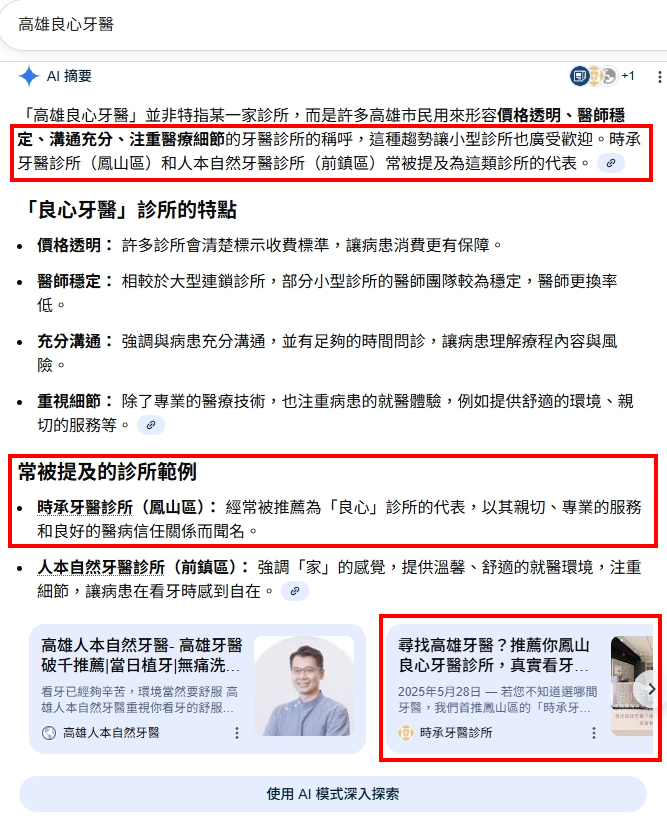
[Dental Clinic]
- Keyword: “conscientious dentist in Kaohsiung”
- Article: Looking for a Dentist in Kaohsiung? A Real Experience & Recommendation for a Conscientious Dental Clinic in Fengshan
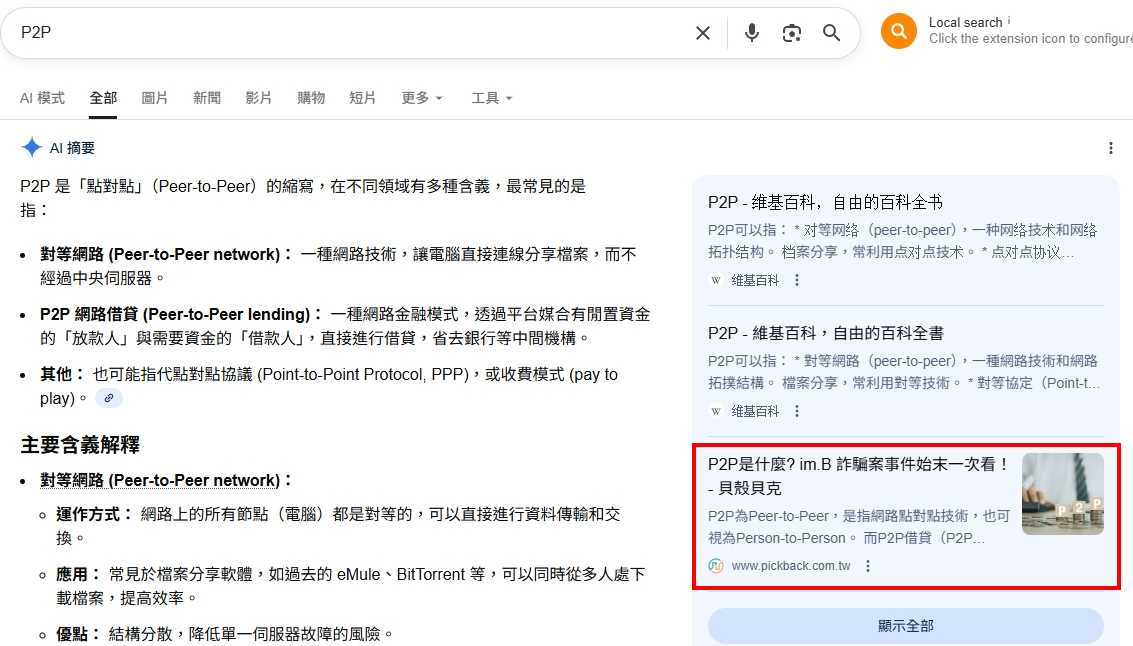
[Investment]
- Keyword: P2P
- Article: What Is P2P? A Complete Timeline of the im.B Fraud Case — Pickback
[Insurance]
- Keyword: insurance transfer for car ownership change
- Article: How to Transfer Insurance When Transferring Car Ownership? Process & Fees (2025 Updated)
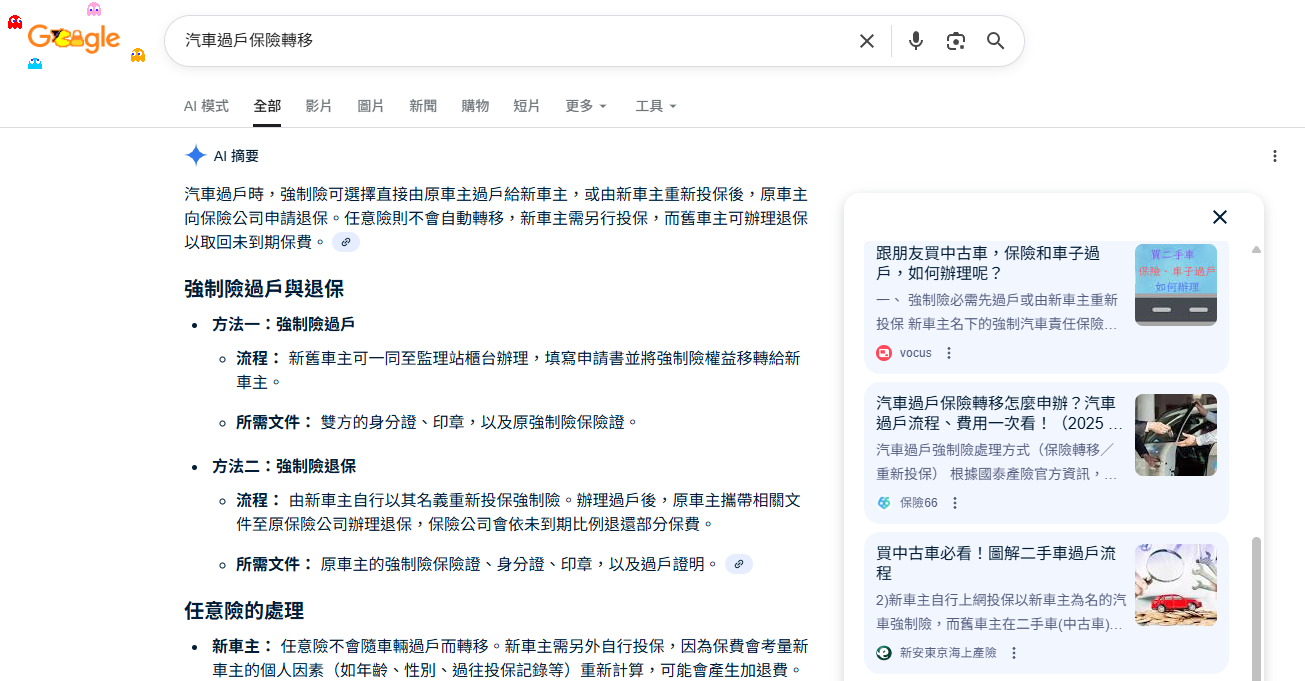
These topics all use clear “steps, definitions, and comparisons,” making them easy for AI to reorganize into summaries.
>> See more Codepulse real AI case studies
4. How AI Overview Appears—and When It’s Excluded
1) Placement in search results
AI Overview may appear:
- At the very top of the SERP
- In the middle
- Near the end of the AI summary section
- On mobile, placement adjusts based on screen size
Because it often appears near the top, it can significantly affect CTR (click-through rate). Recently, Codepulse has also noticed increasingly diverse layouts—suggesting Google is still testing which AI summary formats users prefer.
2) Query types that commonly trigger AI Overview
- What is… (definitions)
- How to… (steps)
- Why… (reasons)
- Product comparisons, specs, buying guides
3) Content that typically won’t appear in AI Overview
- Sensitive or high-risk medical advice (diagnosis, treatment decisions, medication guidance)
- Legal judgments or liability predictions (case outcomes, legal advice)
- Adult content
- Highly controversial or dangerous topics
That said, this type of content can still improve overall SEO performance through branding and strong professional E-E-A-T.
5. The Real SEO Impact of AI Overview
1) Content types most likely to lose traffic
- FAQ-style sites
- Pure informational blogs
- Content without strong brand differentiation
Because AI can show the answer directly, users may not click through.
2) Branded vs non-branded keywords
- Branded keywords (less impact): users specifically want you
- Non-branded keywords (more impact): easier to be replaced by summaries
3) Content that can actually gain traffic
- Bullet-point content
- Clear, summarizable steps
- High-authority content
If cited by AI, brand visibility can increase dramatically.
6. How to Increase Your Chances of Being Cited in AI Overview
This is the most important question in SEO right now. Below are Codepulse’s practical tactics and optimization methods.
1) Strengthen E-E-A-T (Experience, Expertise, Authority, Trust)
- Author credentials and background
- Cite reliable sources
- Update content regularly
- Clear section and paragraph structure
Especially for YMYL topics, this becomes a decisive factor.
E-E-A-T: 4 Components and How to Improve Them
| Factor | Definition | How to optimize |
| Experience | Real experience or case evidence | Add practical examples and author experience |
| Expertise | Professional qualifications of the author | Provide education, job title, certifications |
| Authority | Whether the content is seen as a credible source | Build topic clusters and earn authoritative backlinks |
| Trust | Website reliability and safety | Keep content updated and cite authoritative references |
2) Use structured data (Schema)
AI must understand your content, so Schema is important. Common structured data types include:
- FAQ Schema
- Article Schema
- Product Schema
- Local Business Schema
Common Schema Types and Best Use Cases
| Schema Type | Use Case | Best for | SEO benefits |
| FAQ Schema | Multiple FAQs; improved semantic understanding needed | Q&A, service explanations, process questions, product QA | Higher AI summary citation rate, stronger NLP understanding, richer SERP presence |
| Article Schema | Long-form content; potential news/citation use | Tutorials, blog posts, press releases, in-depth content | Helps Google classify content; improves stability and trust signals |
| Product Schema | E-commerce, product comparisons, pricing | Specs, reviews, pricing, inventory status | Enables rich results; boosts CTR and AI citation likelihood |
| Local Business Schema | Physical storefronts or local services | Pawn shops, law firms, clinics, restaurants, local services | Improves local visibility and Google Maps rankings |
3) Provide “short answer + bullet takeaways”
AI loves content that includes:
- A clear conclusion in 1–2 sentences
- Bullet-point steps or comparisons
- One topic per paragraph
4) Use tables, comparison charts, and flow diagrams
AI often treats these as “highly structured content,” which makes them easier to cite.
5) Build topic clusters
This helps AI recognize your site as a “content hub” for the topic—making citations more likely.
7. AI Overview FAQ
Q1: How do I use AI Overview?
A: Simply type a question into Google Search. If the query meets triggering conditions, AI Overview will automatically appear near the top of the results page. No additional setup is required—users can just read the condensed answer provided by AI.
Q2. Will AI Overview affect my visibility?
Yes. But if you’re cited, you may gain even higher brand visibility than before.
Q3. Will AI Overview cause traffic to drop?
Some purely informational pages may drop in traffic, but being cited can increase conversions and brand exposure.
Q4. How can I improve my chances of being cited in AI summaries?
Structure, short answers, bullet points, E-E-A-T, and Schema are all essential.
Q5. Will e-commerce sites be affected by AI summaries?
Product comparisons and specs can still be cited. We recommend strengthening product tables and buying guides.
Q6. Can I prevent AI from taking my traffic?
Not completely—but you can increase “irreplaceability” through branded content, deeper insights, and topic clusters.
Want to win visibility in the AI search era? Choose AI SEO with Codepulse!
As AI search becomes mainstream, content must be quickly understood by both users and AI in order to maintain exposure in AI Overview and reduce the risk of traffic being replaced.
If you’re rethinking your content strategy or want to improve your chances of being cited in AI SERPs, Codepulse offers a complete AI SEO consulting service. From content depth and topic clusters to structured data and AI-friendly formatting, we help businesses grow steadily in the new search environment.
If you want higher brand visibility and truly AI-era-ready website content, feel free to contact us. Let Codepulse be your most trusted strategic partner in the AI search era.
